 Auto Trader California
The exterior gets washed, the oil gets changed on schedule, and the tires get rotated. Interior maintenance? That tends to happen reactively — after a smell becomes impossible to ignore, or a crack has spread across the dashboard, or the headliner starts drooping at the edges. The details that live inside a vehicle are easy to dismiss because deterioration usually creeps rather than announces itself. By the time most owners notice, repairs cost two or three times what prevention would have. Here is where that gap typically opens up, and how to close it before it gets expensive.
The Headliner and Trim Gaps Nobody Inspects
The headliner is one of the more structurally misunderstood components in a vehicle interior. Most people think of it as fabric, but it is actually a fiberglass or composite board bonded with adhesive foam, then covered with a textile layer. That foam deteriorates with heat and humidity over time — a process that accelerates sharply in regions with extreme summer temperatures or high interior moisture. Once the adhesive breaks down, the fabric separates from the board and begins to sag.
What makes this expensive is timing. A headliner caught early, when the fabric has begun to bubble in one corner, can often be re-glued and stretched back for under $150 at most trim shops. Left alone for another season, the foam crumbles entirely and the board itself warps — at that stage, a full headliner replacement typically runs $300 to $600 depending on vehicle size and fabric choice, with luxury vehicles climbing higher.
The adjacent trim pieces — the A, B, and C pillars, the sun visor mounting points, and the dome light surround — often separate from their clips at the same time. These look cosmetic but function as noise dampening and, in some vehicles, house side curtain airbag channels. A pillar trim that has lost its clip retention may not deploy correctly in an accident.
A practical inspection takes about five minutes: press gently along the headliner surface every six months to feel for soft or unsupported areas, and check that all pillar trim pieces click firmly back into place if pushed. If anything feels loose, address it before the next summer heat cycle compounds the damage.
Seat Fabric and Leather That Gets Ignored Until It Cracks
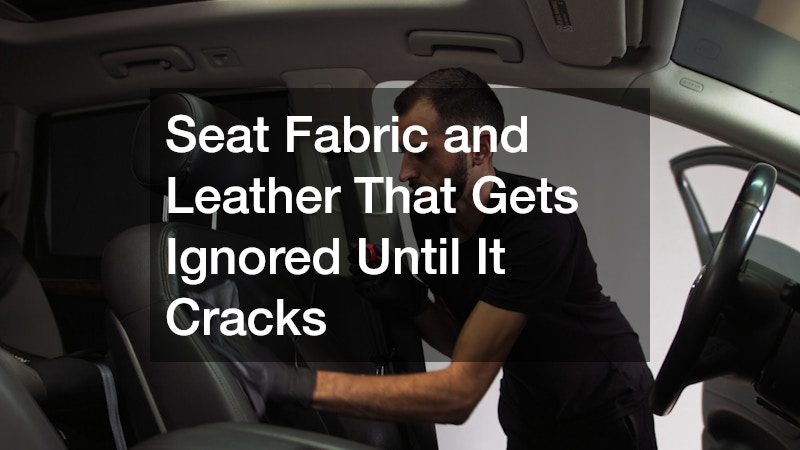
Leather and leatherette seats often signal their own deterioration years before they fail visibly. The surface becomes tacky, then dull, then begins micro-cracking — a process most owners misread as normal aging rather than active damage. By the time a crack is wide enough to notice easily, the material underneath has usually dried out completely and is no longer pliable. At that stage, patching is a cosmetic fix at best; re-covering or replacing the seat panels becomes necessary.
The economics here make a strong case for conditioning. A quality leather conditioner applied every three to four months costs $15 to $25 per application and takes under ten minutes per seat. Neglect that routine for two or three years and a seat re-covering job runs anywhere from $400 per seat for basic material to well over $1,000 for matched OEM-grade leather — and that is before factoring in heated seat connections or built-in airbag panels, which require professional disassembly.
Fabric seats carry a different risk: trapped moisture. Spills that soak through to the foam padding underneath do not dry on their own in the compressed environment beneath seat fabric. That moisture creates the conditions for mold growth and structural foam degradation. Enzyme-based cleaners, not general upholstery sprays, are what actually break down organic residues in deep spills — a detail worth knowing before reaching for whatever cleaner is nearest.
There is also a resale dimension. Used car buyers and dealers inspect seat condition closely, and cracked or stained seats are among the most frequently cited reasons for downward price adjustments at trade-in.
Carpets, Floor Mats, and What Lives Underneath Them
Floor mats get replaced. What they protect is almost never inspected. The OEM carpet layer beneath the mats absorbs road noise, insulates against heat from the floor pan, and — critically — is the first line of defense against rust if moisture finds its way in through a door seal, sunroof drain, or HVAC condensation path.
Vehicles with slow, undetected water intrusion develop rust on the floor pan itself, which is a structural issue, not a cosmetic one. The repair cost for floor pan rust varies widely, but full section replacement in a single area can easily reach $800 to $2,000 depending on how far the damage has spread. Catching it at the surface treatment stage — when the metal shows light surface oxidation but is still structurally sound — costs a fraction of that.
The inspection routine is straightforward: lift both front floor mats and press down on the carpet with both hands. Carpet that feels damp or crunches (from dried mineral deposits) suggests water intrusion. If it smells musty even after a dry week, suspect a leak source rather than residual humidity.
Replacement floor mats present a genuine decision point. Rubber or thermoplastic mats contain water and allow easy cleaning — the better choice for wet climates or vehicles used by children. Fabric mats look cleaner and reduce noise but absorb spills rather than channeling them away. For most daily drivers, rubber mats over the OEM carpet, with periodic removal and carpet inspection, is the stronger long-term strategy.
Buttons, Switches, and the Dashboard Surface Few Owners Treat
Dashboard plastics degrade from UV exposure at a rate that surprises most owners. The surface does not crack uniformly — it becomes progressively more brittle in direct sunlight zones (the upper dash shelf being the most vulnerable) while remaining pliable lower down. When a crack finally opens across a dashboard, replacement in mid-size vehicles can exceed $1,500 once labor, airbag sensor integration, and defrost grid connections are factored in.
UV-blocking interior protectants, applied every six to eight weeks on sun-exposed surfaces, extend the life of dashboard plastics significantly. These are not the glossy silicone sprays that were common in earlier decades — modern formulations are matte-finish and specifically designed to block UV rather than just add surface sheen.
Buttons and switches on high-touch surfaces — window controls, seat adjusters, climate knobs — wear through their printed legends and then their tactile response. Individual switch replacement is inexpensive when addressed early; waiting until the assembly fails entirely often means replacing the entire door panel control cluster, which on newer vehicles with integrated touch surfaces can run $300 to $700 per door.
For those scheduling more intensive interior restoration, the condition of seat fabrics and trim stitching directly affects what a shop quotes: damaged material costs more to prepare and prime before auto upholstery work can begin, which is why early intervention consistently produces lower final invoices.
When Small Interior Problems Signal Bigger Underlying Issues
Interior deterioration is not always what it appears on the surface. A persistent musty odor despite clean carpets and seats often points to a malfunctioning cabin air filter — but if replacing the filter does not resolve it, the HVAC evaporator housing is the next place to look. Mold on an evaporator core is a health concern and an expensive repair, typically $400 to $900 at a dealership.
Electrical gremlins in interior switches — lights that flicker, windows that respond slowly, locks that cycle on their own — are worth diagnosing before they cascade. Modern vehicles integrate interior electronics tightly enough that a failing body control module can mimic what looks like half a dozen unrelated switch failures. A diagnostic scan at an independent shop (usually $80 to $120) often identifies the actual source before owners spend hundreds replacing parts that were not the problem.
Interior issues that seem cosmetic frequently carry structural, mechanical, or health implications that justify prompt attention. The pattern across all of them is the same: the longer the delay, the higher the eventual cost and the fewer options available for repair.